Archive/Method
Method & ethics
How the Recordings Are Made
Equipment, consent, what we edit and what we refuse to edit, and how the archive is expected to outlive the project.
Equipment and setting
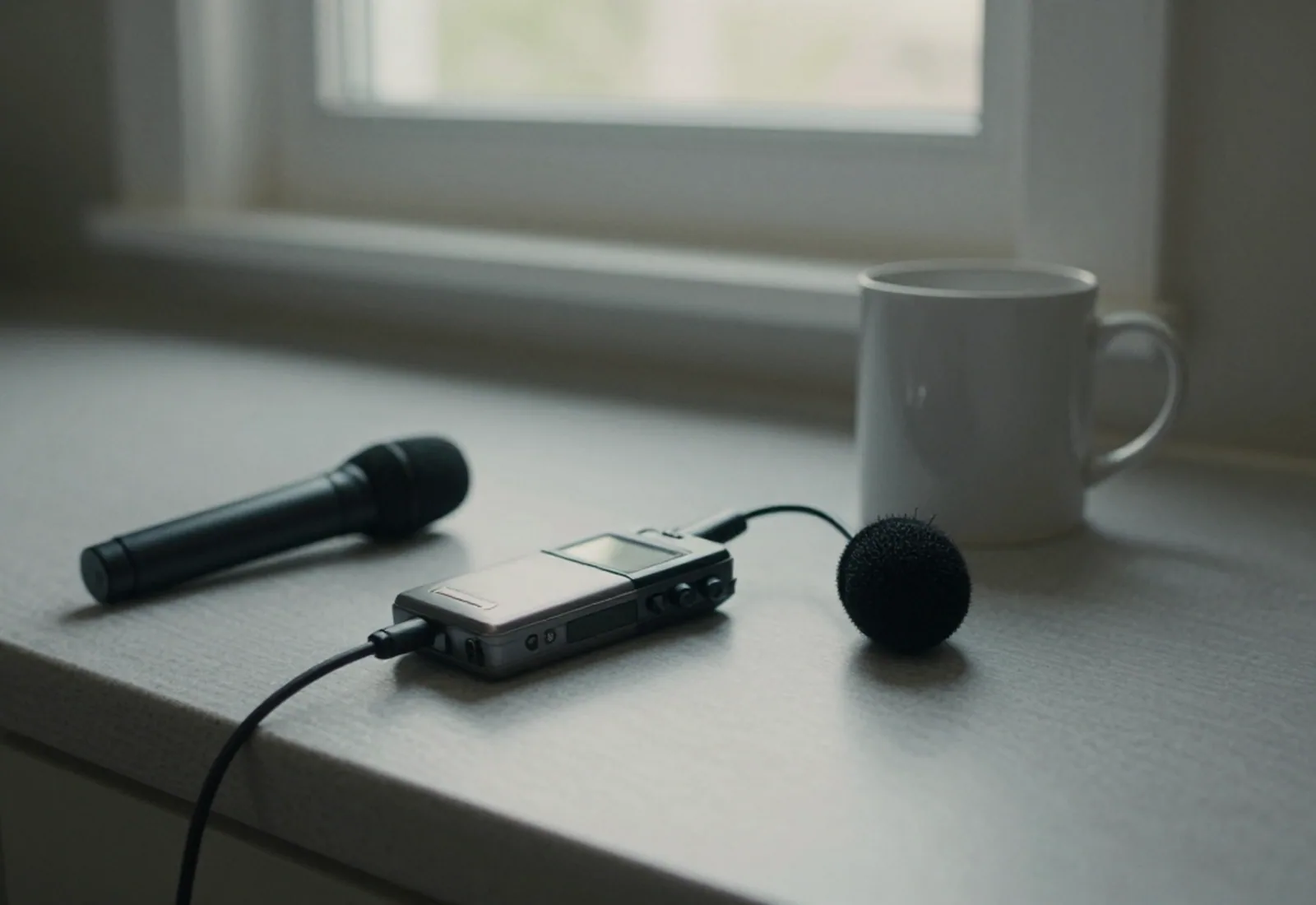
Recordings are made on a handheld solid-state recorder at 48 kHz, 24-bit, with a lapel microphone on the subject and the internal capsules as a safety track. There is always a second recorder running. There is never a crew, and there is never lighting, because both change what people say.
The subject chooses the location. Roughly a third choose their own kitchen, a third choose a depot, canteen or yard, and a third choose the vehicle. Vehicle recordings have more noise and we publish them anyway; a recording that sounds like the place it was made is worth more than a clean one made somewhere neutral.
Sessions run between one and three hours. We do not conduct interviews in more than two sittings, and we do not conduct them at the end of a night shift unless the subject insists, which they occasionally do.
Consent
Consent is taken twice: once in writing before recording, and once after the subject has heard the audio and read the transcript. The second is the one that matters. Nothing is published on the strength of the first alone.
Consent is revocable without a reason and without a deadline. If a subject withdraws, the page comes down within five working days, the record is closed to access, and the master is retained but sealed. We do not delete masters, because a sealed recording can be reopened by the subject or their family later and a deleted one cannot. This is explained before anyone signs anything.
Where a subject's employer requires review, we say so on the record page, and we say how long it took. Employers may object to material that identifies patients, customers, incidents or commercially sensitive routes. They may not object to tone, and we have refused on that ground three times.
Editing policy
The master recording is never edited. It is stored complete, including the pauses, the interruptions, the phone calls and the parts where the subject asks us to stop, which are marked but not removed.
Published excerpts are selected, not smoothed. We remove nothing from within an excerpt except where it identifies a third party who has not consented, and where we do remove something we mark it. Hesitations, repetitions, false starts, dialect and swearing all stay in. So does the interviewer's clumsiness.
Timecodes on every excerpt refer to the master file, so a researcher can find the passage and hear what came before and after it. This is the single most important thing on the page and the one most often removed by publishers who mean well.
Preservation
Masters are held in two geographically separate locations plus an offline copy, in an uncompressed format, with checksums verified annually. Transcripts are held as plain text alongside the audio, because a proprietary document format is a preservation risk and a plain text file is not.
Catalogue records follow standard oral history description practice, so that the archive can be transferred whole to an institution if the project ends. An agreement is in place with a regional records office to accept the collection in that event. Every subject is told this before recording, because they are consenting to an archive and not to a website.
This site is the smallest part of the project. It is a window onto the archive, and it is designed so that if it disappeared tomorrow nothing of any real value would be lost.
Standing commitments
- The master recording is never edited, shortened or improved.
- Consent can be withdrawn at any time, for any reason or none.
- Nothing is published before the subject has heard it and agreed in writing.
- Every published excerpt carries a timecode into the master file.
- Subjects are never paid, and neither are interviewers.
- We do not accept funding that comes with editorial conditions.
- Off-the-record material stays off the record permanently.
- The collection has a home to go to if the project closes.
Researchers are welcome and we mean it.
Full audio and transcripts are available on written request for any published record, and for unpublished records where the subject has agreed to research access.